Rock Forms Worth Reading
Famous rock formations are rarely freak accidents of nature. When you visit Preikestolen, Trollveggen, or Hårteigen, look past the queue of cameras to inspect the spacing of fractures, the orientation of mineral foliation, and the angle of unloading joints. Every silhouette reflects how a specific rock type responds to gravity and ice removal.
Joint-Bounded Cliffs: Preikestolen, Kjeragbolten & Trolltunga
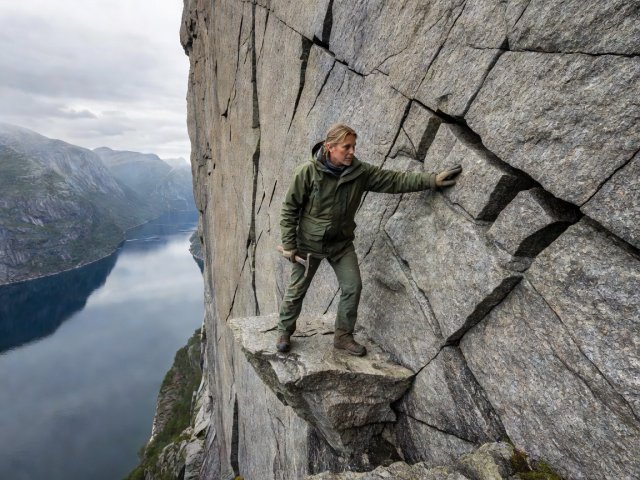
Why is the summit of Preikestolen (Pulpit Rock, 604 m above Lysefjorden) an almost perfect 25-by-25-metre square with flat horizontal footing and vertical ninety-degree edges? Because the Precambrian granitic gneiss there is cut by an orthogonal joint system—three sets of fractures intersecting at right angles.
When the Lysefjord glacier melted away at the end of the last ice age, the cliff lost the lateral support of the ice wall. Tensional stress-release fractures opened parallel to the fjord wall (seen today as the wide crack across the neck of the plateau), while freeze-thaw water wedged away adjacent rectangular blocks, leaving one flat-topped prism projecting out into space.
-
Kjeragbolten (984 m above Lysefjorden)
A 5-cubic-metre rounded glacial boulder wedged tightly into a vertical strike-slip joint cleft. As the glacier thinned ~10,000 years ago, meltwater or retreating ice margin settling dropped the sub-rounded erratic into the narrowing V-profile of the bedrock crack.
-
Trolltunga (Ringedalsvatnet, Odda)
A cantilevered wedge of Precambrian gneiss jutting horizontally from a cirque-like wall. Foliation planes dip gently into the cliffside, giving the projecting slab high tensile strength against snapping while frost action excavated the weaker rock band directly beneath it.
Trollveggen, Hårteigen, Stetind & Torghatten
Not all Norwegian cliffs are static relics of the ice age; many are actively reshaping themselves today through rockfalls (steinsprang) and exfoliation.
-
Trollveggen (The Troll Wall, Romsdalen)
Rising 1,000 metres vertically above its massive talus apron (and 1,700 m from the valley floor), these jagged spires of high-grade migmatitic gneiss are riven by steep faults. Major rockfalls in 1998 and afterward have left pale, unweathered scars on the upper face where fresh mineral surfaces haven’t yet grown dark lichen.
-
Hårteigen (1,690 m, Hardangervidda’s “Hat” Mountain)
A textbook klippe (erosional outlier). Its sheer circular crown is a stranded remnant of hard Precambrian granite from an upper Caledonian thrust sheet, resting on a sloping pedestal of softer Cambro-Silurian phyllite and quartzite.
-
Stetind (1,392 m, Tysfjord, Nordland)
An obelisk of 1.79-billion-year-old Proterozoic granite shaped by concentric exfoliation (avskalling). As overlying rock eroded away, pressure release caused curved onion-skin slabs to peel off, leaving smooth, steep, unglaciated upper slabs (a classic nunatak profile).
-
Torghatten (Brønnøy, Helgeland Coast)
Pierced by a natural tunnel 160 m long and 35 m high. Today the tunnel floor sits 112 metres above sea level, but during the close of the ice age, the land was depressed by ice weight and ocean waves crashed directly at that elevation, excavating a weak, fractured zone in the gneiss before post-glacial rebound lifted the cave high and dry.
How to Photograph Geological Structure in Natural Light
To document a landscape so that another walker can read its geology, avoid flat midday light or heavy saturation filters that obscure mineral textures. Use these field-proven setups:
1. Use Grazing Light (Streiflys) for Micro-Relief: Shoot glacial striations, roche moutonnée surfaces, and folded gneiss when the sun is 10° to 20° above the horizon. Sidelight casts crisp shadows inside 2-millimetre scratches that vanish completely at noon.
2. Wet vs. Dry Bedrock Surfaces: Overcast drizzle is ideal for roadcut mineralogy. Wet gneiss and gabbro lose surface dust scatter, revealing stark contrasts between pink potassium feldspar, white plagioclase, and dark biotite bands (use a circular polariser to control glare).
3. Include a Human Scale at Contacts: A cliff face without a walker, rucksack, or notebook looks the same whether it is two metres tall or two hundred metres tall. Position a companion safely near a thrust boundary or erratic boulder to anchor the scale.